


Tunisian-Born EMEL Delivers Protest Music at a Time When It’s Needed Most
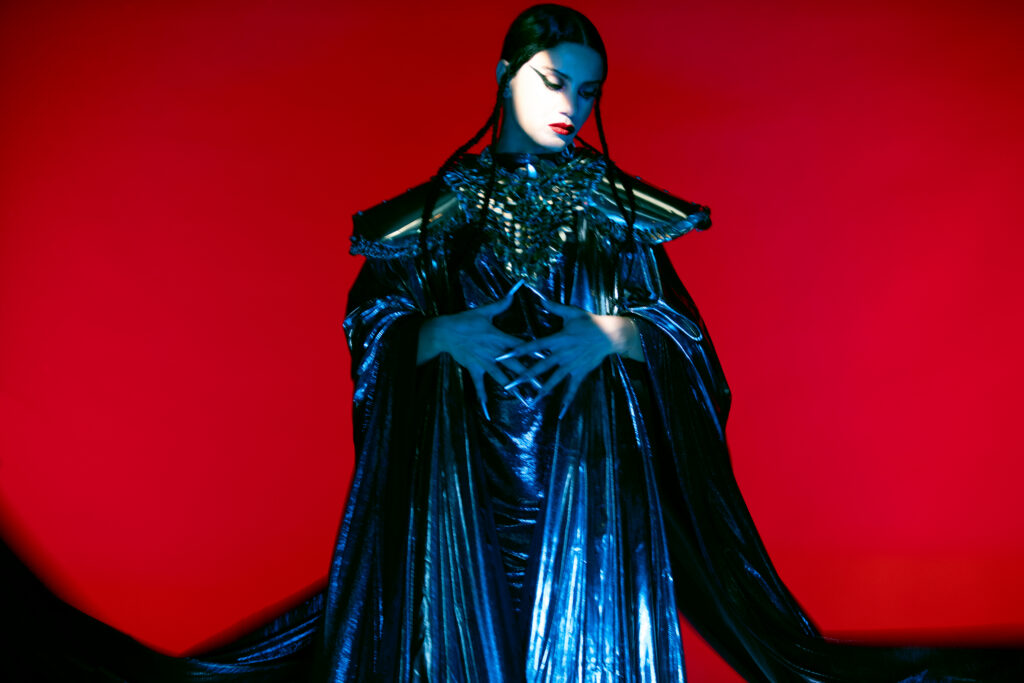
With her new album, MRA, Tunisan-born/New York-based artist, producer and activist EMEL (Emel Mathlouthi, 237k Instagram followers) delivers an intoxicating mix of world beat, electronica and hip-hop, which is on full display in a new live video of her performing “Massive Will” at Le Centquatre in Paris. With a full band backing her, she is hitting the road this spring; she speaks about the album and tour via Zoom from her New York home.
Your new album, MRA, is so sonically dense and engaging. Talk about what the live show will be like.
The live show is very dynamic. It’s very tribal. We have a lot of percussion going on. It’s very rhythm-oriented. We have video installations for each song. We’re trying to depict something really artsy and abstract but also convey the different messages of the song to all the different communities that are underrepresented in society. We’ve been taking the show on the road since last May.
You grew up in Tunisia. What kind of music did you listen to? Was there one singer who made you wanna sing?
I think I was into singing Bjork starting out. That ignited my passion for singing. I was using my vocals and realizing the skill that I had. It was very transformative for me. I think I started singing when I was 8 years old. I developed a passion for really singing and being a singer when I was 15. Joan Baez made me conscious about the power of having a voice that goes beyond singing and using your voice to move people and change.
Was it difficult to access music?
I had access to my dad’s vinyl collection and through other friends, vinyl and CDs. That’s how I came to know Joan Baez.
Were you aware of trip-hop, acts like Portishead, Massive Attack, and Tricky.
I didn’t start into electronic music initially, but eventually I liked Massive Attack’s concoction of very emotional music paired with interesting production.
Your debut album came out in 2012. Was it difficult to complete that album?
I recorded a bunch of things leading to that. It was hard to find the right structure because of the unusual mix of what I was doing. It was political and also interesting production and an eclectic mix of different influences. People always had a different idea of what I should be doing with my voice and my song. I was never exactly where I was expected to be.
Your protest song “Kelmti Horra” (“My Word is Free”), became an anthem for the Tunisian revolution and the Arab Spring. What was it like to see that happen?
I was definitely surprised because it’s not a song to sing along to. It’s not molded as a pop song; it’s a very heartfelt song. In my ears, it always sounded like something to bring the crowds together even before I sang it to anyone. I always heard it with a big choir and orchestra. It had an uplifting side to it. I felt really proud because we don’t have a tradition in the Arab region where songs accompany social change. Being a woman and having this song that’s not just a bunch of verses. It’s really a very musical piece. It’s very creative and orchestrated. To me, it gives me hope that when we do something with a lot of heart and depth, it always translates and touches anybody.
Your first English language album, Everywhere We Looked Was Burning, was influenced by American poets like T.S. Eliot and John Ashbury. How’d you find out about them?
I’ve always been very moved by poetry. The only thing that gives meaning to anything we’re doing is poetry in words or thoughts or rhythms. I really felt drawn to John Ashbery. I was also reading Rilke at the same time. I found them in a house I was renting in upstate New York. I loved the imagery. The poetry that I really like is when there are so many strong images and references to nature and emotions. I feel like it’s so powerful when someone’s poetry leads your imagination. My vocabulary was so enriched. I love abstraction, but the emotion that it draws is super close to the skin. It’s so vivid and humane. It connected to me. I was trying to write this record in the middle of nature with all these haunted things like the past and the uncertainty of the planet and everything. All of a sudden, I felt like these poets connected the dots.
Talk about MRA. What inspired you to want to work with female musicians?
It started with me wanting to challenge my label. I didn’t like whoever was suggested at the time. All of a sudden, I thought, “Why does it always have to be a guy?” I am a producer. As a woman producer, you always doubt yourself. Being a revolutionary and rebel, I have been putting albums out for ten years. I was working 99 percent of the time with guys. I thought I cannot be a feminist and not do something concrete action for other females.. In the music industry, the statistics speak to themselves. We are underrepresented. I thought the problem is that we women do not make other women participate. Men hire men, and women hire men. There is always this cycle. To break the cycle, i thought I had to share my platform with other women. I wanted to explore what a sorority means. I thought my vision was supported in the way it was never supported before. I don’t want to speak in cliches, but it is true that there was some energy. We feel we come from oppression. We are the most oppressed and we’re not even a mintory I felt so embarrassed of myself. Having a strong voice is not enough to represent yourself and project this idea.
I love the vibe of “Lose My Mind” and how it incorporates hip-hop. Talk about working with Nayomi.
She’s fantastic. I always loved hip-hop but never experimented with it. It’s so close to people in general and to me. I wanted to experiment with rappers who rap in Arabic and Persian. It was so interesting to explore different rap languages. Female rappers are underrepresented. I need to have a rapper rapping in Arabaic. I was singing in English. People expect me to sing in Arabic, but I wanted to mix it up and sing in English and have her sing in Arabic to surprise people. I had her rap in.Diferent.
Many of your songs are directed at the Arab world. What similarities and differences do you see between the repression there and the repression happening here in the U.S. and how does your music speak to both?
For a long time, I was so angry that I wasn’t recognized enough for my music. It’s always “the voice of the revolution.” After COVID, I realized there are not that many artists doing something political. I thought I need to be proud that I can speak up. I like experimenting with rhythms and music and production, but the core is that it’s very revolutionary. The beats are revolutionary. We are in a protest somehow. The way I see people react at the shows and their reactions and testimonies make me satisfy. I’m not mainstream or rich, but it’s important what I’m doing. We need to create that collective awareness and collective power to push back and push for all the rights we are trying to love.
Photo credit: Girlie Action Media
Jeff